
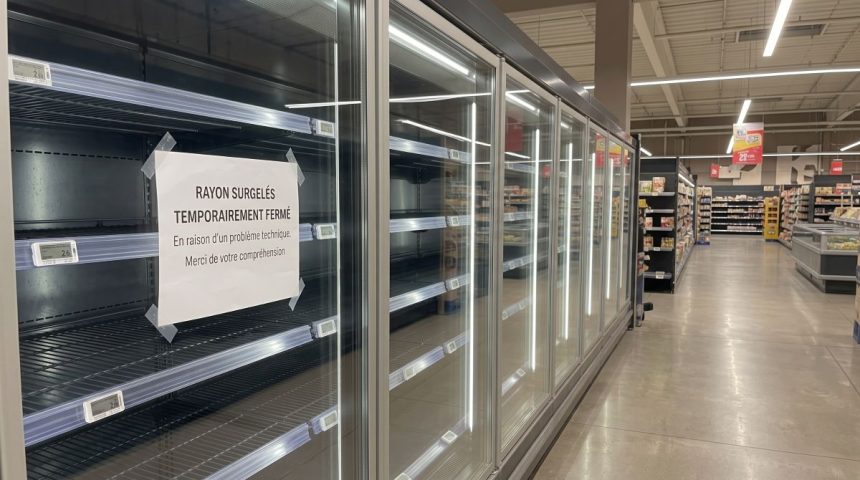
A French supermarket cyberattack turned refrigeration equipment into a costly source of disruption, with some stores reporting temperatures as high as 50°C. Attackers interfered with remotely managed cooling systems overnight on October 11–12, 2026, forcing affected retailers to discard fresh and frozen products.
The incident reached hundreds of stores across several chains. However, being targeted did not always mean losing stock: some shops reportedly reacted quickly enough to protect their goods.
France’s cybersecurity authority has since expanded its warning beyond the initially identified Danfoss equipment. Its updated advisory also names Copeland XWEB and Dixell XWEB systems.
How the French supermarket cyberattack disrupted cooling
Illustrative photograph by Dominik on Unsplash. This is not an affected French store.
Supermarket refrigeration relies on connected controllers that coordinate cooling equipment, schedules, alarms, and defrost cycles. Remote management helps maintenance teams monitor multiple locations, but it also creates access that must be protected.
Les Mousquetaires, the group behind Intermarché and Netto, reported that affected equipment was placed into defrost mode and heated to extreme temperatures. Other retailers reporting disruption included Carrefour, Coopérative U, Monoprix, and E.Leclerc.
Pen Test Partners explains that sustained overheating involves more than changing a thermostat setting. Refrigeration equipment includes defrost heaters, and abnormal operation can move an incident beyond food spoilage into potential equipment damage. That technical explanation should not be confused with a confirmed account of every affected installation.
Which refrigeration controllers are affected?
CERT-FR’s advisory, updated on October 16, 2026, identifies these equipment families:
| Manufacturer or brand | Equipment named in the advisory |
| Danfoss | AK-SM series |
| Danfoss | AK-SC series |
| Copeland | XWEB |
| Dixell | XWEB |
The advisory confirms numerous compromises and warns that attack campaigns are probably continuing. It does not identify a single entry method that explains every incident.
Older equipment makes recovery harder
Some affected Danfoss products were already beyond their support lifecycle. Reporting identified the AK-SM 800 and AK-SC 355 as older models no longer receiving software or security updates. Some newer AK-SM 800A units reportedly ran outdated firmware.
This creates two different maintenance problems. Supported equipment needs the appropriate updates and secure configuration. Unsupported equipment also needs a replacement plan, because resetting it cannot create security fixes that the manufacturer no longer supplies.
CERT-FR explicitly warns that a factory reset alone leaves vulnerable, internet-exposed equipment open to another compromise.
What remains unknown about the attackers?
The original report did not establish who carried out the intrusion or which vulnerability provided access. Previously disclosed controller flaws are relevant background, but their existence does not prove they were used in this attack.
Pen Test Partners has described weaknesses involving exposed management interfaces and date-derived access mechanisms. Its analysis helps explain the risk, while attribution and the precise intrusion chain remain separate investigative questions.
How operators should protect refrigeration systems
CERT-FR recommends removing direct public-internet exposure and restoring remote administration through a secure VPN or protected network. Restricting access to a contractor’s source IP addresses can provide an emergency measure, but the agency says it should not become the permanent solution.
Operators should also review the full configuration, particularly defrost schedules, apply manufacturer guidance, update firmware where supported, and replace default passwords.
Changes should be coordinated with refrigeration specialists. Disconnecting remote access, restoring settings, or resetting a controller can affect monitoring and operations, so the recovery plan must account for the equipment’s physical role.
Why this incident matters beyond supermarkets
The French supermarket cyberattack shows how a compromised management interface can affect products, equipment, and business continuity.
A practical review should establish who owns each controller, how contractors reach it, whether it remains supported, and who receives temperature alarms. Pen Test Partners highlights undocumented third-party connections as a particular concern: equipment can become publicly reachable without the retailer’s security team having a clear record of that access.
For businesses running connected physical systems, those questions belong alongside the usual checks for servers, laptops, and cloud accounts.