

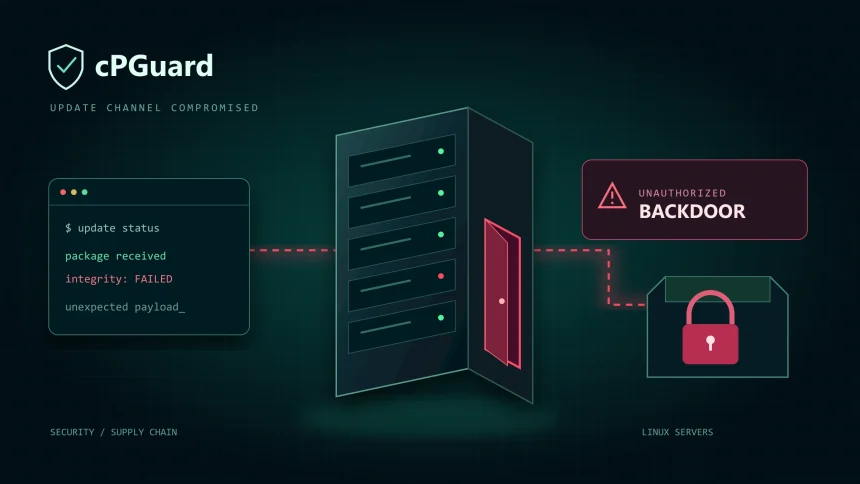
A cPGuard update attack delivered a backdoor and collected sensitive Linux server files, OPSSHIELD says. Compromised credentials gave an unidentified attacker access to its update infrastructure on November 2, 2026.
Which versions carried the malicious update?
Versions 5.88.12 through 5.88.19 were affected. OPSSHIELD stopped distribution and released cleanup in 5.88.25 and later.
The attacker retrieved an estimated 32 collected files, each associated with a customer server. That preliminary figure does not establish the total exposure.
What the cPGuard update attack collected
Targeted material included Linux password hashes, root database settings, shell history and SSH files. Updating cannot revoke credentials already copied.

Check versions and replace exposed credentials
Administrators should run cpgcli update --start, then cpgcli --version to confirm 5.88.25 or later. Update history can be checked with:
grep 'Successfully updated' /opt/cpguard/logs/install_logAn affected entry signals potential compromise, not proven execution or transfer. Missing entries do not establish safety.
For potentially affected servers, OPSSHIELD calls for local password resets from trusted recovery, rotation of database and cloud secrets, and replacement of root SSH keys, including removal of old trusted public keys.
Recovery extends beyond installing a fix
General incident-response guidance from CISA adds a useful framework for recovery. Teams should record the incident timeline, reset compromised accounts and test security controls before returning systems to normal operation.
CISA also recommends reviewing monitoring gaps and updating detections after an incident. These are broader recovery practices, rather than findings about additional activity in the cPGuard update attack.
The immediate task is to track cleanup and credential replacement separately. A successful software update answers whether a corrective version is installed. It cannot, by itself, establish what happened before that update.
Follow our cybersecurity coverage for more software security reports.