
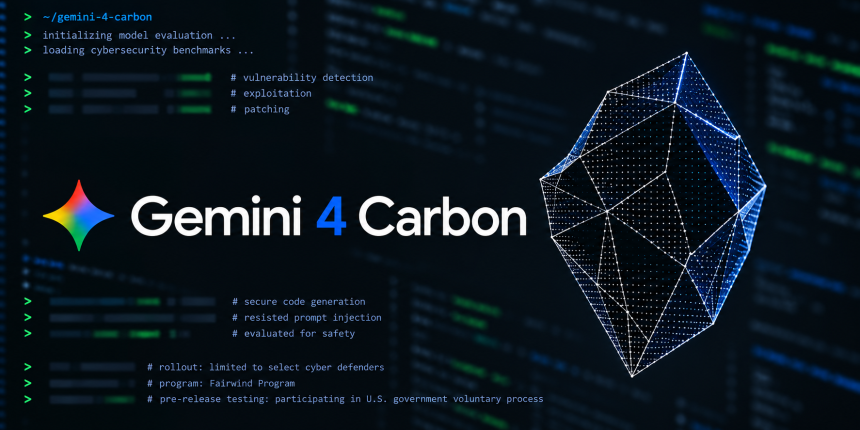
Gemini 4 Carbon leads Google’s latest comparison of AI models on benchmarks for discovering vulnerabilities, validating exploits, and producing patches. Announced on October 28, 2026, the model scored 88.2% on SEC-bench Pro, 54.8% on ExploitGym, and 71.0% on CWE-bench.
Those results cover three distinct parts of security work. Finding a flaw does not automatically prove it is exploitable, and a working exploit does not establish that a proposed patch is correct. Carbon’s results are encouraging across that sequence, but the evidence behind each score differs.
The main qualification is that the three figures are not a uniform, independently run comparison. Collinear AI evaluates CWE-bench, while Google computed its SEC-bench Pro and ExploitGym results using its own agent setup. Google also says the external cybersecurity evaluations were conducted without guardrails.
| Benchmark | Carbon’s reported score | What to check |
|---|---|---|
| SEC-bench Pro | 88.2% | The JavaScript-engine task split and judging rules |
| ExploitGym | 54.8% | The 10-hour time limit and mitigations-off setting |
| CWE-bench v1 | 71.0% | Programmatic pass@1, separate from pass@4 |
1. Gemini 4 Carbon leads the vulnerability-discovery comparison
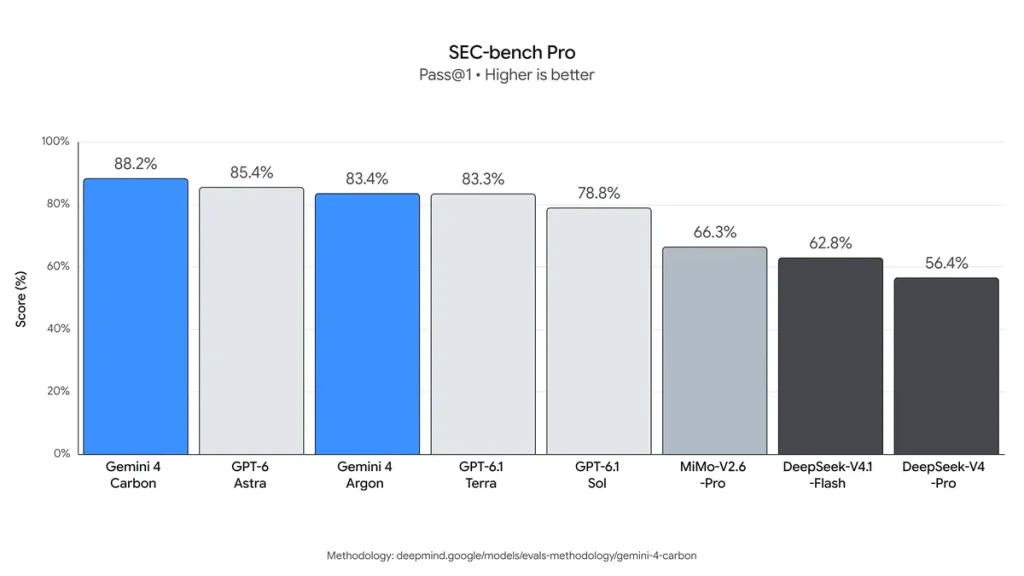
Google’s SEC-bench Pro chart places Carbon at 88.2%, ahead of GPT-6 Astra at 85.4% and Gemini 4 Argon at 83.4%. The gap between Carbon and Astra is 2.8 percentage points, calculated from the reported scores.
The methodology narrows what that headline means. Google used the benchmark’s 183-task May 2026 JavaScript-engine split, with its Antigravity agent harness, and averaged three independent attempts per task.
Its judging process checks whether a proof of concept crashes the vulnerable build rather than the patched build. It also allows a source-reviewing model judge to validate the intended vulnerability in certain cases where both builds crash. These are specific evaluation rules, not a claim that Carbon finds 88.2% of every organization’s security flaws.
The results support a lead in the comparison Google published. They should not be treated as a universal detection rate across unrelated software, languages, or production environments. Google’s evaluation methodology specifies the setup.
2. ExploitGym results depend on the time limit
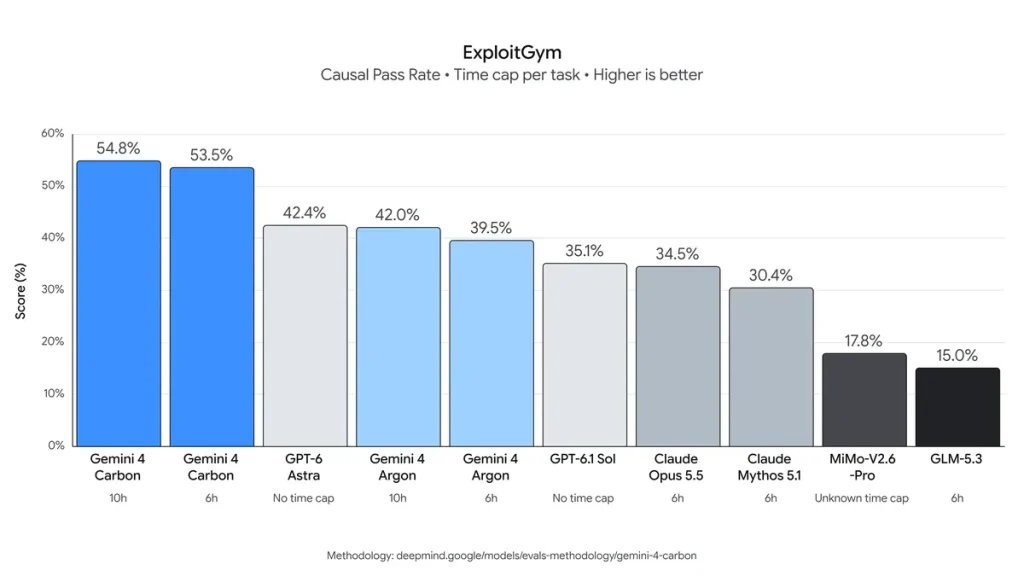
On ExploitGym, Google’s chart reports 54.8% with a 10-hour cap and 53.5% with a six-hour cap for Carbon. Argon reaches 42.0% at 10 hours and 39.5% at six hours. Carbon’s improvement over Argon is therefore 12.8 percentage points in the 10-hour comparison and 14.0 points at six hours.
Google ran these tests offline, with one attempt per task and mitigations switched off. A successful result requires capturing the target flag and a model judge verifying that the intended vulnerability was exploited.
The comparison chart mixes other time conditions: Astra’s 42.4% is labeled without a time cap, while Opus 5.5’s 34.5% uses six hours. Carbon remains ahead of the entries shown, but the headline scores do not represent identical budgets for every system.
For defenders, this distinction affects how the result should be evaluated. A model that succeeds after hours of investigation may be valuable, but the score alone does not reveal the cost or turnaround time of a particular security workflow. These are controlled benchmark results, rather than evidence of unauthorized attacks against live services.
3. CWE-bench puts Carbon first for defensive patching
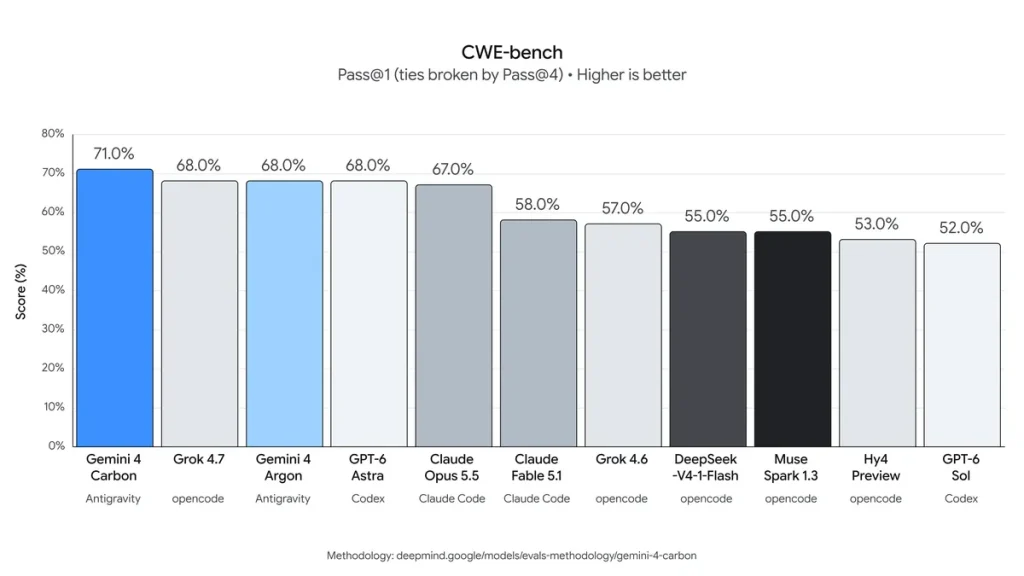
The clearest benchmark-owner confirmation comes from Collinear AI’s CWE-bench v1 leaderboard. As checked on October 29, Carbon ranks first at 71% programmatic pass@1, compared with 68% for Grok 4.7, Argon, and Astra, and 67% for Opus 5.5.
CWE-bench uses 120 held-out audit-and-patch tasks covering 73 weakness types. Agents receive a codebase without being told which vulnerabilities it contains. The checks require the vulnerability to be blocked while existing functionality still works; agents are not asked to generate exploits.
Each model receives four rollouts per task, with a one-hour limit for each rollout. Carbon’s programmatic pass@4 score is 81%, which answers a different question from the headline pass@1 measure. The leaderboard also provides a separate judge-panel assessment.
The three-point lead is useful evidence, but remains a relatively small margin on one task set. The benchmark evaluates a model together with its harness: Carbon uses Antigravity, while competing systems use other agent tools. Collinear has not yet published Carbon’s average cost per rollout.
4. Benchmark leadership has practical limits
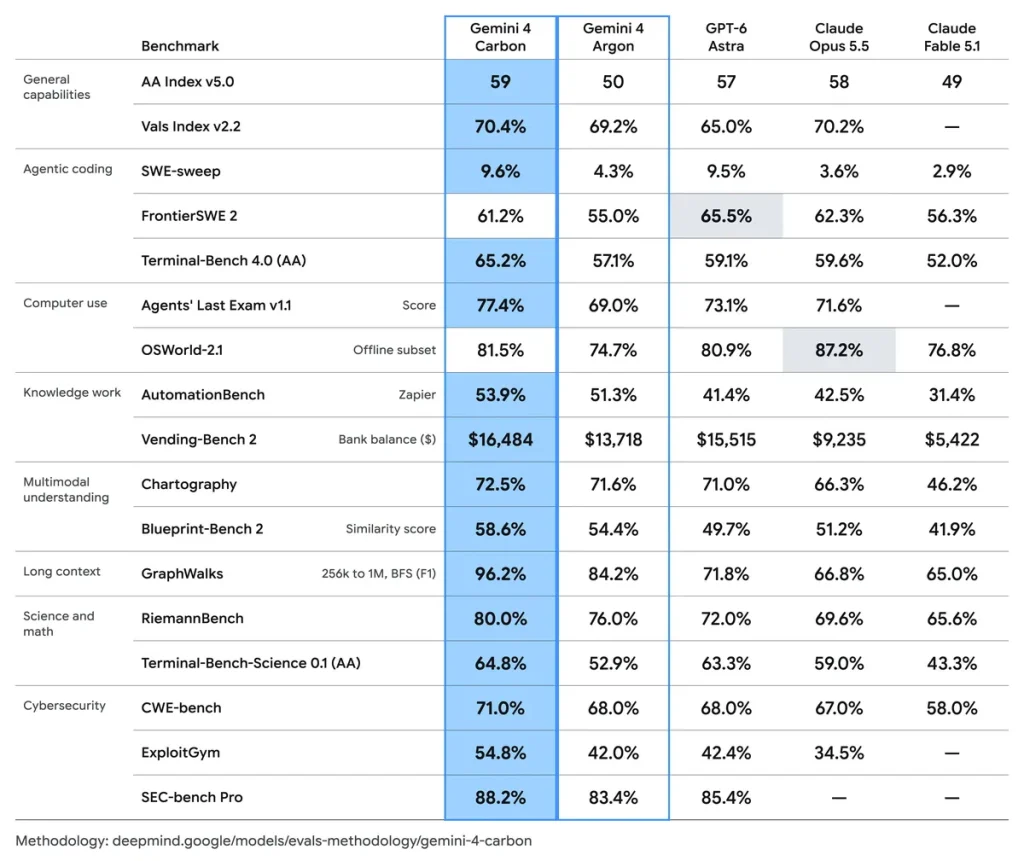
Google’s broader results table shows why a security lead should not become a claim of winning every AI task. Carbon scores 61.2% on FrontierSWE 2, below Astra’s 65.5% and Opus 5.5’s 62.3%. On the OSWorld-2.1 offline subset, Carbon’s 81.5% trails Opus 5.5’s 87.2%.
These are different evaluations with different scoring rules, so they should not be averaged casually into one verdict. A team assessing Gemini 4 Carbon should identify the task it needs performed and examine that benchmark’s conditions, rather than selecting only the most favorable headline.
The guardrail condition matters too. An evaluation run without guardrails does not establish the performance of a customer-facing configuration with deployment restrictions. Nor does success on a test set guarantee that a patch will preserve all behavior in a larger application.
In practice, a useful trial would check confirmed findings, rejected false positives, patch correctness, regressions, reviewer time, and cost on an authorized codebase. That is an evaluation framework for readers, not a claim that we have independently tested Carbon. Human review and regression tests remain essential before deploying a generated fix.
5. Access begins with selected cyber defenders
Google’s October 28 announcement says initial access is going to selected cyber defenders, with additional trusted partners joining through the Fairwind Program. Wider availability for developers, businesses, and consumers is planned, but the announcement does not provide a general-release date.
Fairwind prioritizes organizations such as governments, critical-infrastructure operators, and core technology platforms. Its access process includes vetting and controlled use. The program page still describes Argon in parts of its technology section, so Carbon’s rollout details should be read from its own launch announcement.
| Announced token pricing | Input, per million tokens | Output, per million tokens |
|---|---|---|
| Introductory | $2 | $10 |
| After the introductory period | $4 | $20 |
Google also advertises cached input at a 95% discount to the input rate. The launch post does not specify when the introductory period ends. These token prices do not establish the cost of completing an audit or delivering a reviewed patch.
For now, Carbon offers a strong set of published security results with limited initial access. The next useful evidence will be how those capabilities translate into repeatable, reviewed fixes under the conditions available to the defenders using it.