


The Binance hack on October 29, 2026, moved billions of dollars out of the exchange’s hot wallets and triggered an international effort to freeze the proceeds. Binance put the impact at approximately $6.3 billion. Blockchain investigators published slightly different estimates, but agreed that the incident exceeded the scale of previous cryptocurrency exchange thefts.
The emerging account involves compromised operational systems, unauthorized transactions across multiple blockchains, and a race to move assets before issuers could block them. It is not yet a complete forensic reconstruction. This article separates company disclosures, investigators’ findings, and questions that remain unanswered.
Reporting checked November 1, 2026. Financial estimates and service-restoration plans below are attributed to dated updates, rather than presented as live balances or current platform status.
1. Why the Binance hack reached $6.3 billion
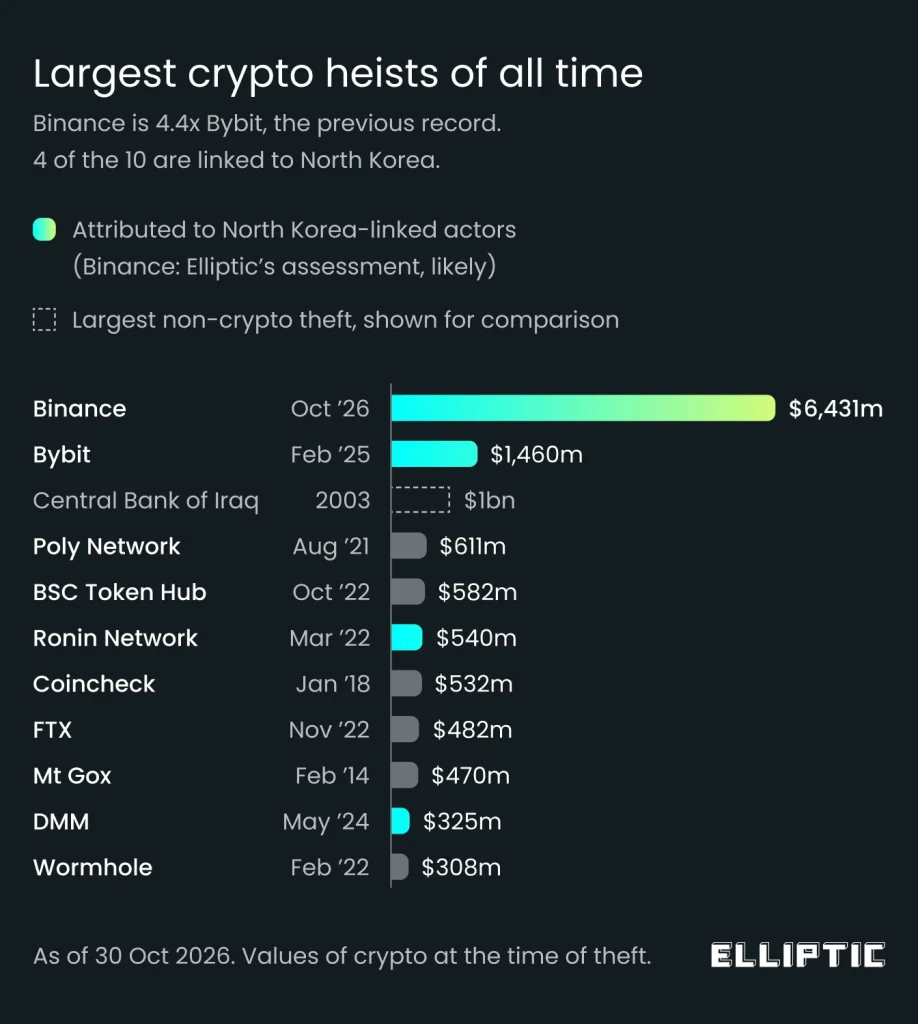
Binance’s estimate describes the overall impact. Independent investigators calculate totals from the transfers they identify and the prices they apply. TRM Labs reported approximately $6.36 billion, while Elliptic calculated approximately $6.43 billion. These are separate estimates of the same incident, not amounts to add together.
The comparison with Bybit is stark. Elliptic valued the February 2025 Bybit theft at roughly $1.46 billion, placing this attack at more than four times that scale. The distinction between stolen, frozen, and replaced funds is just as important as the headline number.
| Figure | What it describes |
|---|---|
| About $6.3 billion | Binance’s reported incident impact |
| About $6.36 billion | TRM’s valuation of traced transfers at the time of theft |
| About $6.43 billion | Elliptic’s independent theft estimate |
| About $3 billion | Binance’s reported on-chain freezes in its October 30 update |
A freeze restricts movement of affected assets. It does not, by itself, establish that those assets have been returned to the exchange or credited to customers.
2. How the attackers reached the withdrawal system
Binance’s initial account pointed to a compromised DevOps engineer’s laptop. Its official news update described an attacker accessing a service container and submitting unauthorized withdrawal transactions. That was a preliminary explanation, not a final root-cause report.
A later institutional update said investigators had identified additional points of compromise. It also said the company had found no evidence that wallet private keys had leaked. Those statements leave room for an attacker to abuse systems authorized to request or sign transactions without extracting the underlying keys.
This distinction matters. A blockchain can accept a correctly signed transaction even when the business process behind that signature has been compromised. The public disclosures do not yet establish the complete initial-access method, every system crossed, or the precise control that failed at each step.
Describing the Binance hack as the work of one infected laptop therefore goes beyond what the company’s later account supports.
3. How signed transactions became a drain on funds
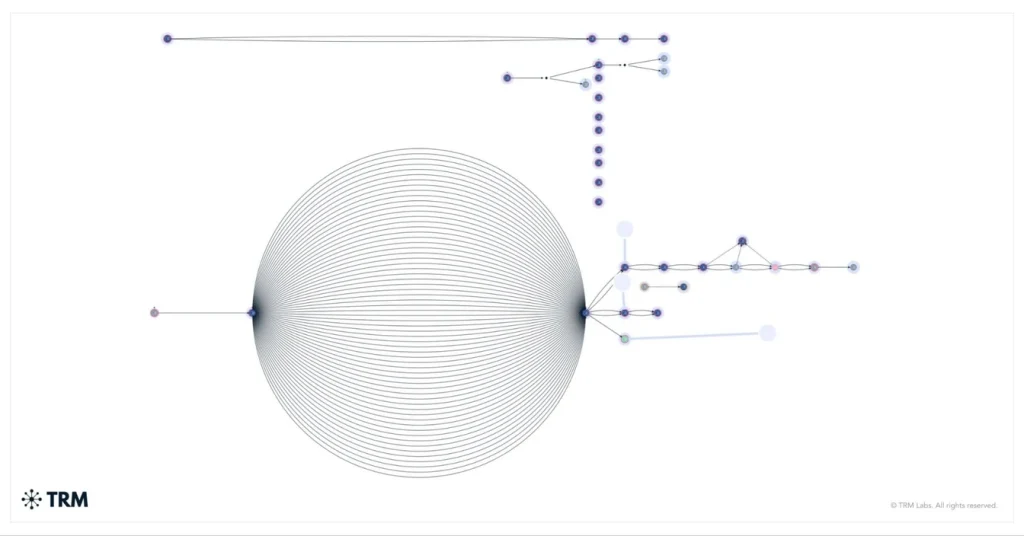
TRM’s reconstruction places the main theft window at approximately 20:05 UTC on October 29, with much of the value moving in about 20 minutes. Its analysis also identified preparation before the theft and later withdrawals.
On Ethereum, investigators identified abuse of EIP-7702, a feature that lets an ordinary account delegate behavior to smart-contract code through signed authorization. TRM reported a batch of 50 authorizations pointing a Binance wallet toward an attacker-controlled sweeper. The wallet was then repeatedly drained, including as additional funds arrived.
Other affected chains showed ordinary signed transfers rather than the same delegation mechanism. TRM interpreted the wider pattern as evidence pointing toward compromised hot-wallet signing infrastructure. That remains an investigative assessment; it should not be confused with a published, complete company post-mortem.
The FBI supplied a separate attribution finding on October 31, naming North Korea’s TraderTraitor activity as responsible for the theft of more than $6 billion. The bureau also reported conversions primarily into ETH and asked industry participants to block transactions associated with identified laundering addresses.
4. Why the losses spread across several blockchains
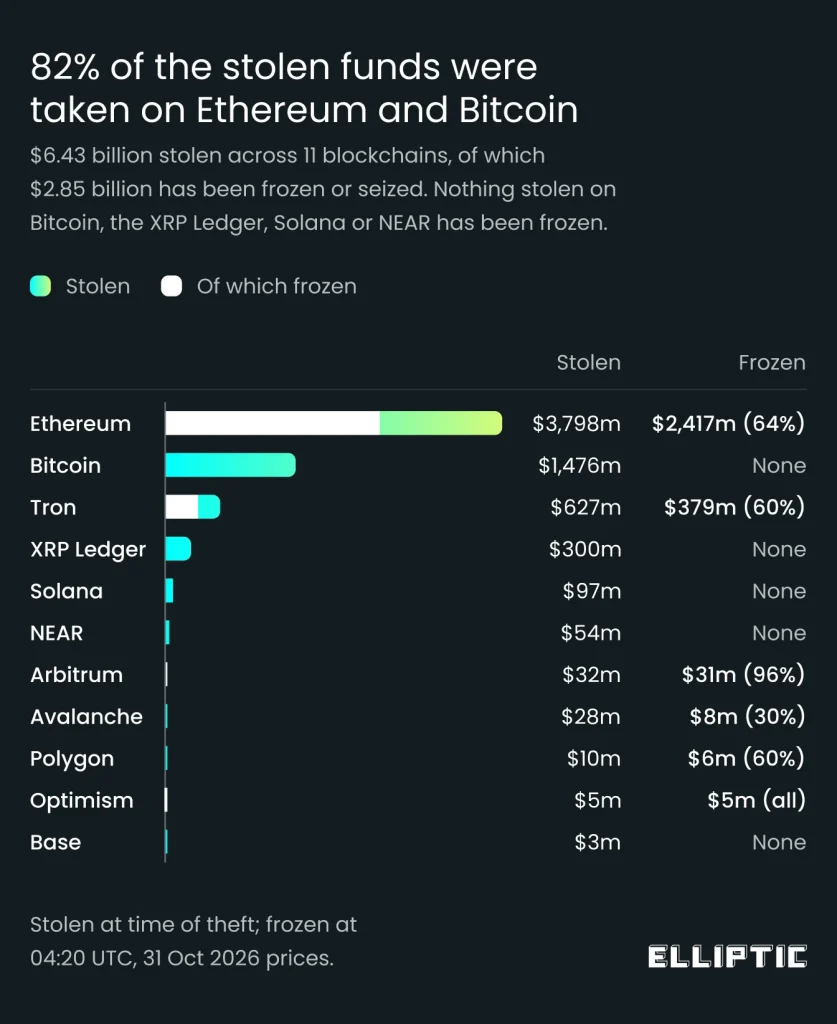
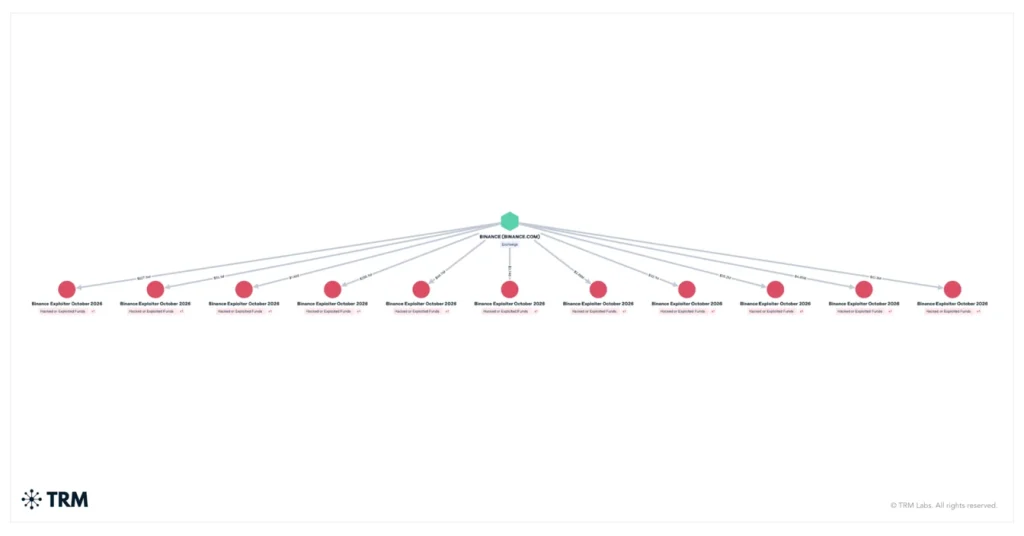
The Binance hack did not consist of one token leaving one wallet. Elliptic’s published breakdown covered 11 blockchains and placed approximately 82% of the stolen value on Ethereum and Bitcoin. Its earlier-snapshot counterpart from TRM covered ten networks, illustrating why scope and timestamps belong beside totals.
Moving assets across different networks complicates containment: issuers, exchanges, and network participants have different powers. A stablecoin issuer may be able to restrict its token, but that does not give it an equivalent power over a blockchain’s native asset.
Investigators also tracked swaps and other attempts to move value away from assets subject to issuer controls. This is why a visible trail on a public blockchain should not be mistaken for an automatic recovery mechanism. Identifying where value went and regaining control of it are different tasks.
5. What frozen funds mean for Binance users
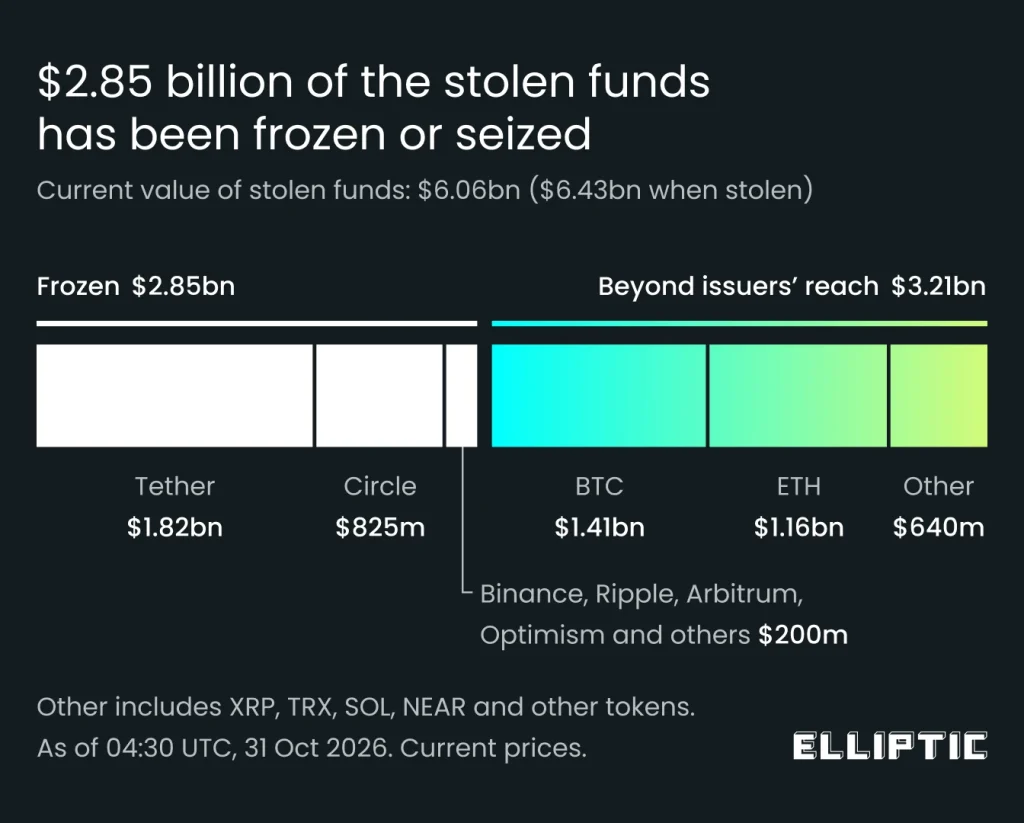
Elliptic’s October 31 snapshot put verified frozen or seized assets at about $2.85 billion, close to Binance’s rounded figure of $3 billion. Its chart records the snapshot time and valuation basis; those numbers should not be treated as an up-to-the-minute recovery total.
In its October 30 institutional update, Binance committed to absorbing losses through SAFU and its treasury. It said more than $6.34 billion in company funds had been set aside, including $5 billion in the affected token assets. It also described a phased withdrawal-restoration plan and targeted November 2 for proof-of-reserves results. These were company commitments and targets, not independently verified completion milestones.
The next meaningful evidence is a detailed incident report, a clear account of restored services, and verifiable information about asset coverage and recoveries. A reserve snapshot can help assess balances, but cannot alone explain how the attack happened or prove that every operational weakness has been resolved.
For account holders, check notices through the official app or a bookmarked website. Treat unsolicited recovery messages, requests for seed phrases, and demands to transfer money to “unlock” an account as suspicious. No public incident report requires you to give a stranger control of your wallet.
The central question is now broader than the amount stolen: how did unauthorized instructions receive valid approvals, and what evidence will show that the same path has been closed?
Sources: Binance institutional update, October 30; Binance’s preliminary incident account; TRM Labs investigation; Elliptic analysis, updated October 31; FBI attribution notice, October 31. Investigation graphics: Elliptic and TRM Labs. Figures reflect the timestamps displayed in the graphics.